Mosquito Recognition
Mosquitoes are small insects that develop in water. They go through four life stages: egg, larva, pupa, and adult. Learning to recognise adult mosquitoes and mosquito larvae helps reduce breeding sites around homes and public spaces. Jump to Adult | Larva
Adult Mosquitoes
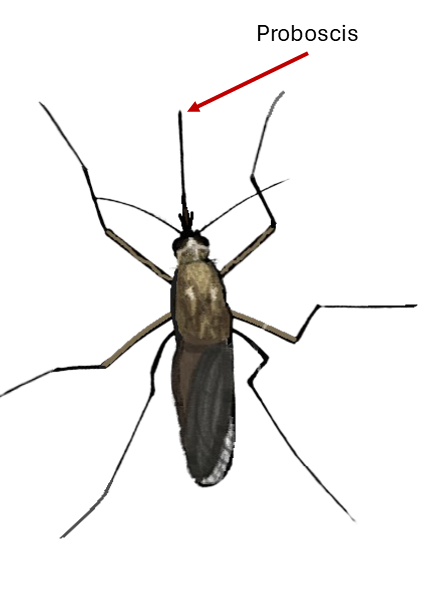
What to look for:
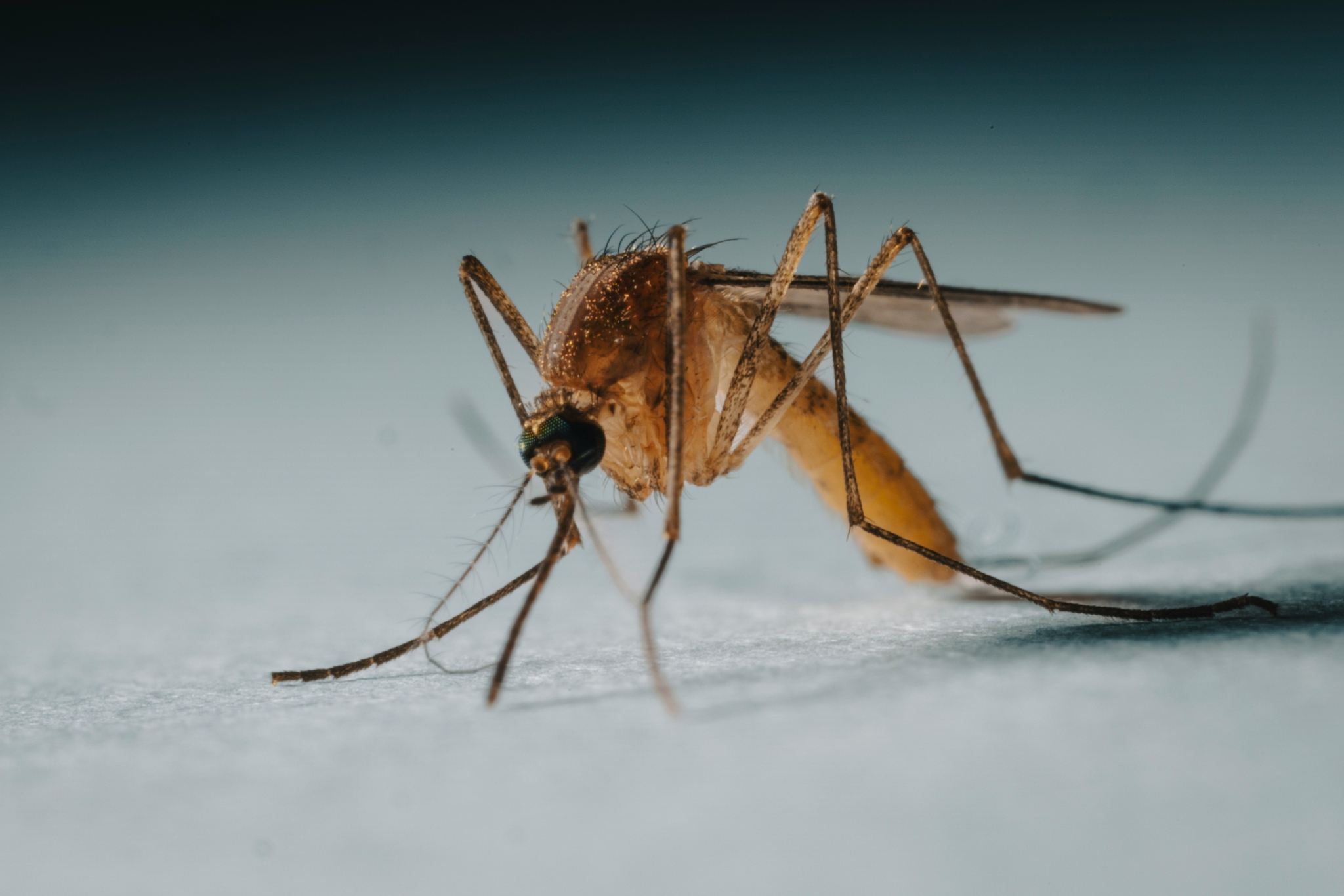
- Long, thin mouthpart (proboscis)
- Small, slender flying insects (usually 4-10 mm)
- Long legs and narrow body
- One pair of wings, with scales
- Often active at dawn, dusk, or night
Only female mosquitoes bite; males do not. In fact, both male and female mosquitoes are an important component of food webs on land and in water and even contribute as pollinators of plants. They have an important ecological role and most species do not cause any human nuisance.
Victims of mistaken identity
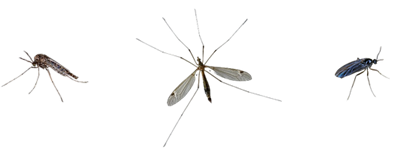
There are several other types of insects that are commonly mistaken for mosquitoes but are harmless. Here are some examples: non-biting midges, fungus gnats, and crane flies.
You might be able to see that none of these insects has a long proboscis, although some of them have long antennae that could be mistaken for a proboscis.
Remember that mosquitoes also have antennae, so mosquitoes have at least* three (two antennae plus one proboscis) long extensions from their heads, while other insects just have two. If you can see at least three head extensions, it is almost certainly a mosquito.
* Male mosquitoes and both sexes of some species have two additional long head extensions either side of the proboscis: the palps.
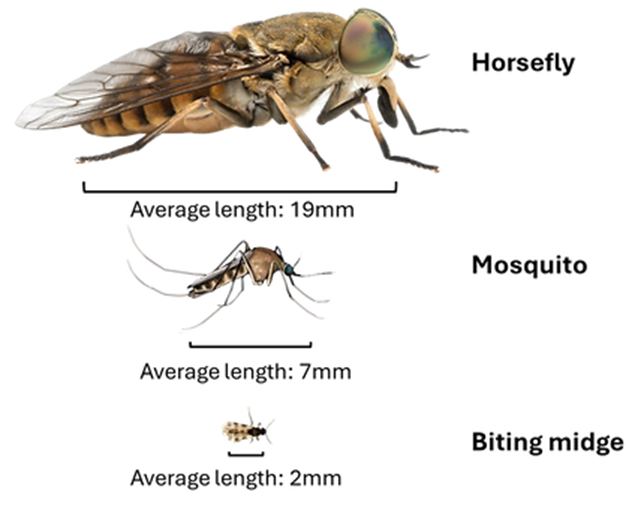
Clegs and biting midges: not-so-innocent victims of mistaken identity
Horseflies and deer flies, colloquially known as ‘clegs’, are common in many parts of Ireland and can be mistaken for mosquitoes due to their inclination to bite. However, they are a separate family of insects. Clegs are much bigger and stouter than mosquitoes and they do not have a proboscis. They have a much more painful bite than a mosquito bite.
Biting midges are abundant in much of Ireland, particularly in rural areas around livestock. Again, they are a separate family to mosquitoes and in this case they are much smaller. They do not have a proboscis. A midge bite is much less painful than a cleg bite but it can still be felt; typically as an itchy sensation.
Invasive tiger mosquitoes – more cases of mistaken identity
Aedes albopictus, known as the tiger mosquito, is an invasive mosquito species that is spreading in many parts of Europe. It is able to transmit several serious diseases, including dengue, chikungunya, and Zika viruses. It is a small black and white mosquito with stripes on its legs. It has not been reported in Ireland, however, there have been repeated occurrences in England in recent years that have been successfully managed.
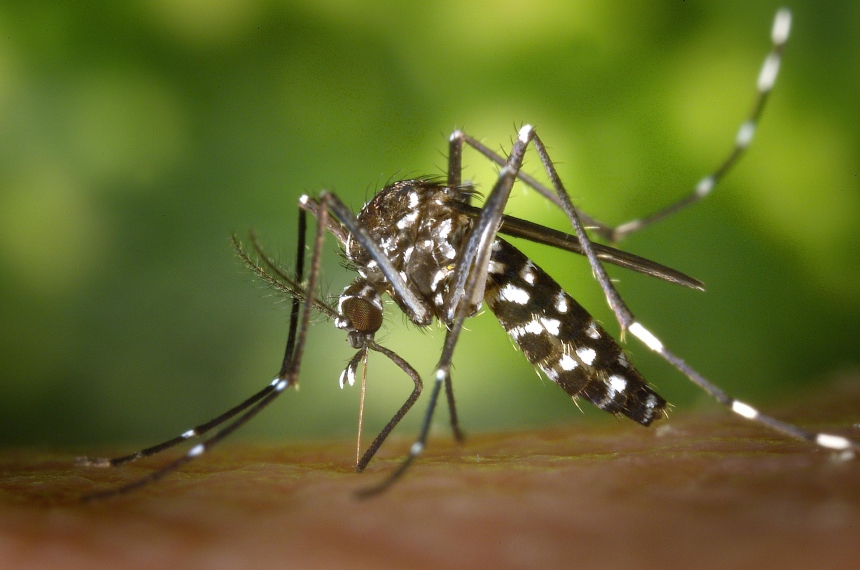
There are several native mosquito species that also have stripes on their legs and may consequently be mistaken for tiger mosquitoes. In particular, the banded mosquito (Culiseta annulata) often causes alarm as it is very large and has black and white colouration.
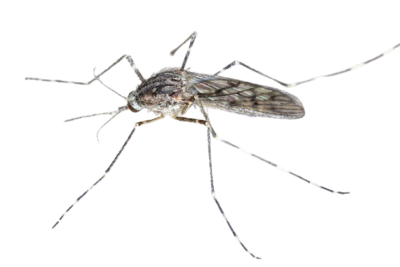
The banded mosquito can cause human biting nuisance indoors, even during the winter. However, there are several key visible differences between the banded mosquito and the tiger mosquito:
- Size: The banded mosquito is almost double the size of the tiger mosquito, with a wing span of up to 15mm compared with approximately 7mm.
- Wings: The banded mosquito has spots on its wings, while the tiger mosquito does not.
- Legs: The tips of the banded mosquito’s legs are black, while the tiger mosquito has white tips at the end of its legs.
Mosquito Larvae
Mosquito larvae live only in water and are easy to spot once you know what to look for. Unless you have a water barrel outside, you might never have seen or noticed mosquito larvae in Ireland.
Mosquito eggs and larvae are found in standing water such as:
- wetlands, like bogs, marshes (including saltmarsh), and flooded grassland
- reedbeds and ponds
- puddles and footprints
- artificial containers that have collected water, such as outdoor buckets, bird baths, water butts, gutters, and plant pots
You will generally not find mosquito larvae in:
- running water (e.g., flowing rivers and burns)
- lakes (apart from at the edges if they are shaded and/or have lots of vegetation)
- the sea
Some mosquito species lay individual eggs on water surfaces or on substrates that are subject to flooding or waterlogging. Eggs are very small (approximately 0.8mm in length) and are only just visible to the naked eye. They are typically dark in colour and have a pointed oval shape.
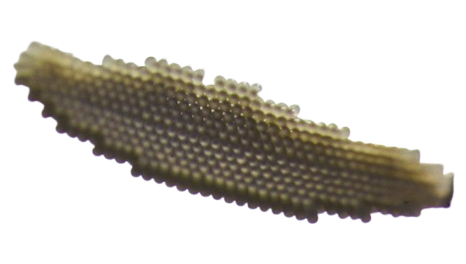
Other mosquito species lay eggs in ‘rafts’: a collection of eggs stuck together on the water surface. Rafts can be up to 1cm in length and can be seen without a microscope. They are normally teardrop, semicircle, or arc-shaped. If you have standing water in containers in your garden, you may see egg rafts at the surface during the spring and summer months.
Mosquito larvae go through four larval stages after hatching. The first stage is very small (approximately 1-2mm in length), but they can grow to over 1cm by the final stage. First stage larvae are usually pale and semi-translucent, but they often look darker and more opaque as they develop.
The most distinctive feature of mosquito larvae is their behaviour. They rest just below the surface of the water to breathe, then wriggle quickly down to the bottom if disturbed. Many mosquito species in Northern Ireland (especially container breeders) hang from the water surface with their head facing downwards, but a few species rest parallel below the surface.
Many mosquito larvae have a siphon, which is a breathing tube at the base of the abdomen. Larvae that have siphons will hang downwards from the surface of the water with the siphon at the surface. Larvae without siphons will rest parallel just below the surface. Siphons can be long and thin, or they can be stubbier and more cone-shaped.
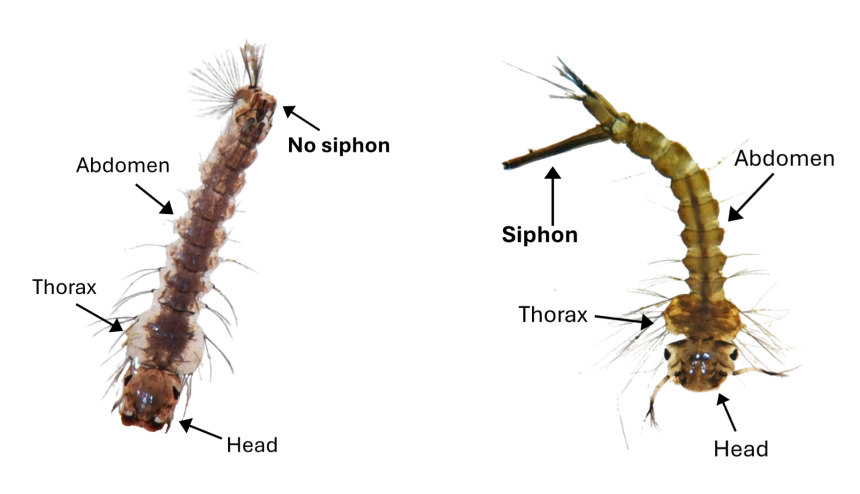
The presence of a siphon is a sure sign that the larva is a mosquito, but the absence of one does not necessarily mean that it’s not a mosquito. Other clues that you have a mosquito larva are:
- An abdomen that is visibly narrower than the head/thorax. The abdomen is the long, segmented section at the bottom of the mosquito. Some other types of insect larvae do not have a clear distinction between the abdomen and the rest of the body, making them look worm-like in appearance. Mosquito larvae usually have a head and thorax (the middle section of the body) that is broader than the abdomen.
- Long hairs on the sides of the body. This might not be obvious to the naked eye, but should be visible under a magnifying glass.
For a more in-depth guide of mosquitoes and their habitats, please see the freely available Wetland Mosquito Survey Handbook from Britain. Many of the covered species are also found in Ireland.